
Scope of Masters of Science in Bioinformatics
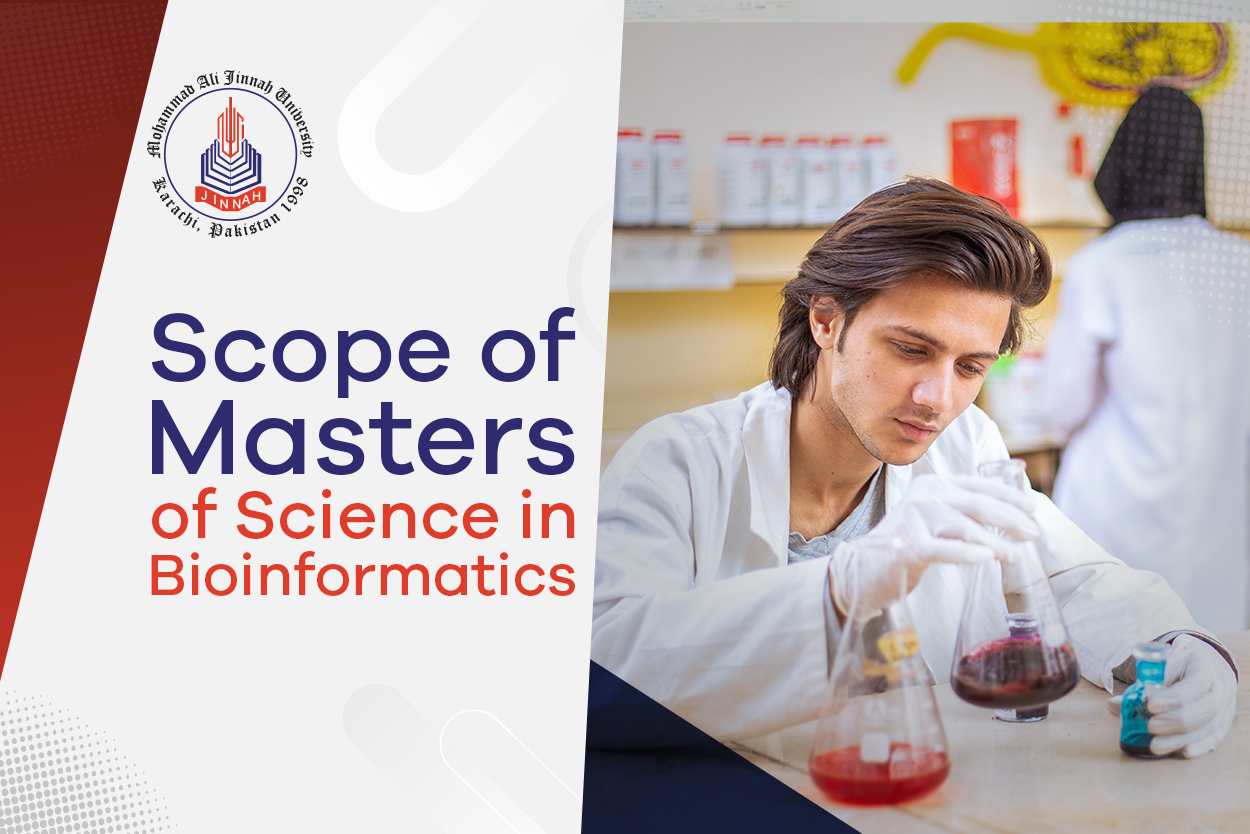
Bioinformatics is an interdisciplinary field of life sciences, combining biology and computational technology. Information technology is applied to the analysis of biological data, drawing on multiple resources. This article explores the scope of the Master of Science in Bioinformatics if pursued in Pakistan. Also, you will learn why Muhammad Ali Jinnah University (MAJU) is one of the top choices for MS Bioinformatics.
What is Bioinformatics?
Before we consider Masters of Science in Bioinformatics, let’s explore the field itself. Genetics and genomics, which involve sequencing and interpreting DNA, are foundational elements of modern biology.
The massive databases generated by these fields are analysed using tools from bioinformatics and models from computational biology. Bioinformatics provides the core principles of managing data. These data analyses work as predictive models in diverse fields like healthcare, agriculture, etc.
Where is Bioinformatics Used?
Bioinformatics is used in modern biology. The layers of data that can be driven, collected, and analysed are huge for a human capacity to process. Therefore, scientists take help from computer science. This combination of biology and computer science results in bioinformatics.
It helps in collecting, storing, and analysing huge biological data.
Bioinformatics helps identify the interesting patterns of biology and the responsible factors of diseases and health problems.
The applications of bioinformatics can help analyse the patient’s genome to make predictions of possible health problems, and to match the most suitable medicine.
Furthermore, in agriculture, bioinformatics can be extremely helpful, like biotechnology in the development of high-yielding crops and drought resistance for the soil to maintain the nutritional value of the crop.
Drug development is also a major beneficiary of the field of bioinformatics. The compound function, target identification, molecular stimulation, validation, and prioritisation are the predictive outcomes of bioinformatics. In a nutshell, bioinformatics is responsible to make sense of the biological processes. Which ultimately helps human brains in problem-solving across multiple fields.
Skills a Professional in Bioinformatics Must Have
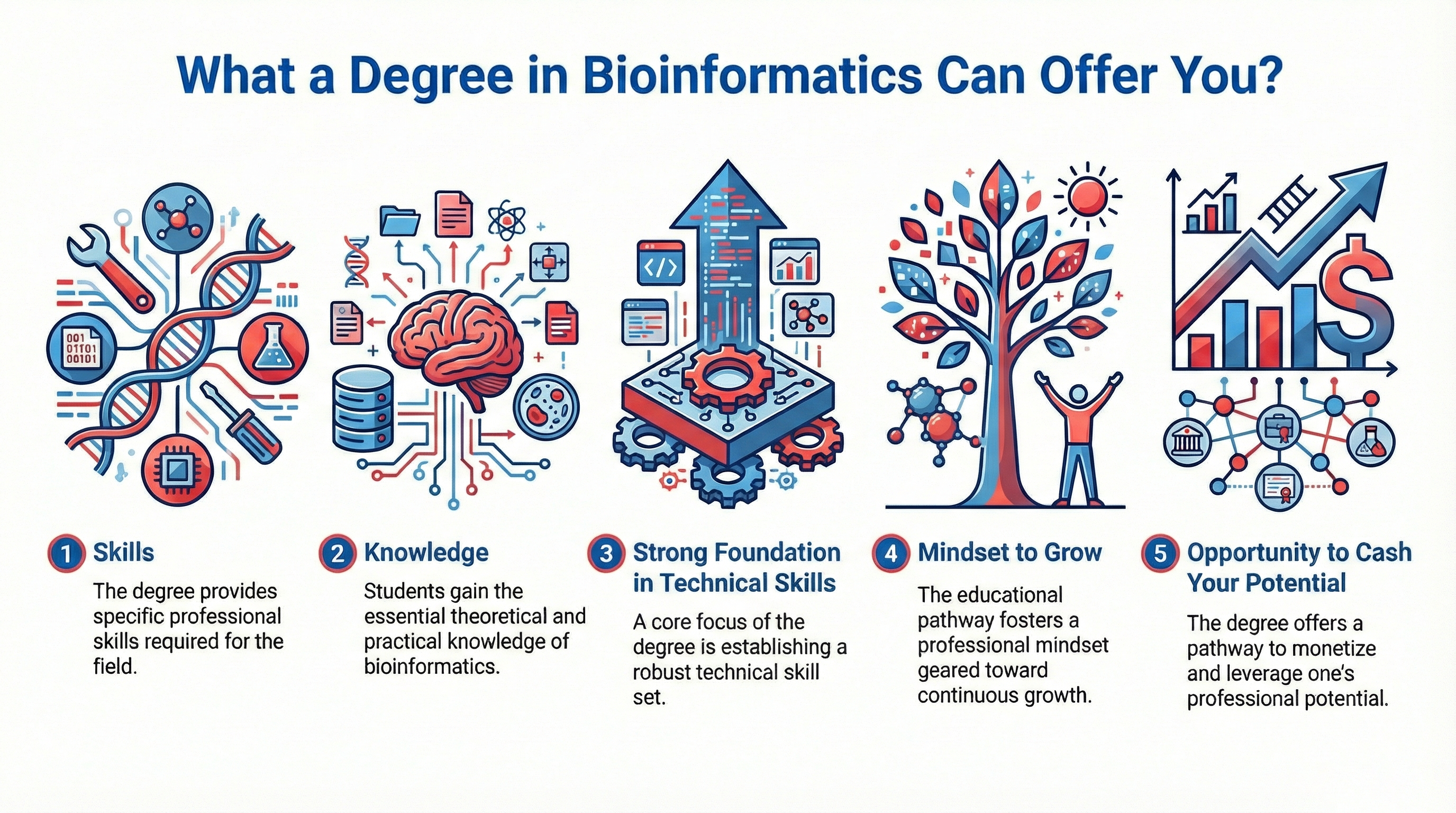
To know the scope of bioinformatics and to exploit it generously, skills and knowledge go together. Though in the practical field, the skills needed by your employer will also vary with the needs of that lab. However, some things are foundational for a bioinformatician to know. Let’s list them as follows.
To attain a solid growth and footprint in the market, you will need a comprehensive set of skills in core areas, technical, soft, and methodologies. A successful professional after a Masters of Science in Bioinformatics must have a sound knowledge base in Biology, Data Sciences, and the concepts of bioinformatics.
Furthermore, for a professional bioinformatician, technical skills are also essential to adapt. Proficiency in Python, Pearl, Java, and C++ is required for some of the major languages used in data sciences.
In addition, you will need SQL, NoSQL, and the ability to solve big-data problems. Furthermore, tools specified with bioinformatics, like BLAST, GATK, Galaxy, Bio Python, and Linux with command line interfaces. Also, take a close understanding of high-performance computing (HPC).
You can also get an idea of the skills you will be great at learning via the Master of Science Bioinformatics.
Jobs & Career Path after Master of Science in Bioinformatics
Let’s explore what the potential job when you enter the job market after completing a Master’s of Science in Bioinformatics. Keeping bioinformatics master’s prerequisites in mind, we know that one must have completed 16 years of education in biological sciences, or computer, or medical.
Fields you can pursue after Masters of Science in Bioinformatics can be as follows.
- Medical Sciences
- Pharmaceuticals
- Biotechnology
- Software Development
- Bioengineering
- Consulting
- Computational Chemistry
- Paleo genomics
- Academia Research
- AI & Software Companies with bioinformatic tools and dealings
The careers you may pursue can be any of the following.
- Bioinformatic Scientists
- Research Scientist
- Biostatistician
- Microbiologist
- Bioinformatician
- Zoologist
- Wildlife Biologist
- Molecular Biologist
A professional with a background in Bioinformatics may earn up to $60000/- on entry-level jobs in the US, annually. With experience and career growth, the range may scale up to $212000. Many of the students ask, is doing a Masters of Science in Bioinformatics is still a viable choice in the wake of AI?. The answer is, yes! The reasons for this choice are as follows.
Advanced sequencing creates large datasets that can be analysed by artificial intelligence in less time and with improved effectiveness. Furthermore, AI in informatics can open doors for revolution and adaptation across industries. Therefore, the present time is undoubtedly the best time to pursue Masters of Science in Bioinformatics.
Can I Study Bioinformatics in Karachi?
While you reside in Pakistan and your location is Karachi, there is no need to relocate to any other country for a degree in bioinformatics. Muhammad Ali Jinnah University in Karachi offers a comprehensive Master of Science in Bioinformatics.
With industry-relevant courses, a modern curriculum, and learned and experienced faculty in related fields, MAJU offers more than a degree. Jinnah University also offers a massive range of scholarships and financial assistance programs. You can join us in Fall 2026 for MS Bioinformatics.
How to Apply at MAJU in Karachi?
We are accepting applications from brilliant, criteria-matching candidates for the Master of Science in Bioinformatics in Spring 2026. You can apply through the online admission portal.
Final Words
Master of Science in Bioinformatics is a great option to pursue a degree combining biological sciences with computation. The complexities of modern sciences need modern solutions. Apply at MAJU in Karachi, in Fall 2026, and take a step forward to lead the world of science tomorrow from the front!
Frequently Asked Questions (FAQs)
- Is Bioinformatics a good degree?
Yes, Bioinformatics is a great option to pursue for students having an interest in biological sciences, data, and computation. - What is the bioinformatics scope in Pakistan?
Bioinformatics has the potential for growth in Pakistan. The bioinformatic professionals can earn handsome amounts across the positions. - Where to study MS Bioinformatics in Karachi?
Muhammad Ali Jinnah University (MAJU) is the top-notch option to study MS Bioinformatics in Karachi, Pakistan. With foreign qualified faculty, rich learning experience, and close industrial ties, students can have a 360- degree learning experience.

You may also like
-

Top 5 Reasons to do PhD Computer Science
29 September, 2026 -

Pursue BS Accounting and Finance in Karachi
11 September, 2026 -

Earn a Master’s Degree in Project Management
28 August, 2026