Muhammad Ali Jinnah UniversityMuhammad Ali Jinnah University
  • Home
  • Explore MAJU  
    • About MAJU
    • Chancellor’s Message
    • President’s Message
    • Portal
    • Student Hand Book  
      • Undergraduate Regulations
      • MS Regulations
      • PhD Regulations
      • General Policies
      • Students’ Discipline  
        • University Dress Code
    • Academic Calendar
    • HEC Digital Library
  • Academics  
    Academics

    We are unlocking new horizons in pursuit of taking their abilities to new heights.

    FACULTY OF ENGINEERING
    • Department of Electrical and Computer Engineering
    FACULTY OF COMPUTING
    • Department of Computer Science
    FACULTY OF BUSINESS ADMINISTRATION
    • Department of Business Administration
    FACULTY OF SOCIAL AND BASIC SCIENCES
    • Department of Psychology
    • Department of Social Sciences
    FACULTY OF LIFE SCIENCES
    • Department of Biosciences
  • Blog
  • Admissions  
    Admissions

    We nurture agents of change, to excel in changing world.

    • Admission Schedule
    • Composition of Admission Test
    • Fee Structure
    • Eligibility Criteria
    • How to Apply
    • Key Points for Foreign Admissions
    • Merit List Preparation
    • Sample Admission Test Papers
    • FAQs
    • Scholarship and Financial Aid Policy
    • Undergraduate Programs
    • 2 Year Undergraduate Programs
    • Graduate Programs
    • Doctorate Programs
  • Why MAJU  
    Why MAJU

    Because road to success begins here.

    Accreditation
    • Engineering program
    • Computing program
    • Business Administration and Social Sciences Programs
    ORIC
    • Objectives
    • Collaborations
    • Publications
    QEC
    • Home
    • Quality Enhancement Cell
    • Message from the Director QEC
    • Vision and Mission
    • QEC Aims
    • QEC Organogram
    • QEC Team
    CSR
    • External Linkages
    • Internships and Placement
    • VIS Directorate
    • Directorate of Sustainability and Environment
  • CAREERS
  • Home
  • Explore MAJU
    • About MAJU
    • Chancellor’s Message
    • President’s Message
    • Portal
    • Student Hand Book
      • Undergraduate Regulations
      • MS Regulations
      • PhD Regulations
      • General Policies
      • Students’ Discipline
        • University Dress Code
    • Academic Calendar
    • HEC Digital Library
  • Academics
    • [Custom]
    • FACULTY OF ENGINEERING
      • Department of Electrical and Computer Engineering
        • MS Electrical Engineering
        • PHD Electrical Engineering
    • FACULTY OF COMPUTING
      • Department of Computer Science
        • BS (Computer Science)
        • BS (SOFTWARE ENGINEERING) – Offered in Spring semester Only
        • MS Computer Science
        • MS Software Engineering
        • PHD Computer Science
    • FACULTY OF BUSINESS ADMINISTRATION
      • Department of Management Science
      • BS Accounting and Finance
      • MS Management Sciences
      • PHD Management Sciences
      • Bachelor Of Business Administration(BBA)
      • Master Of Business Administration(MBA)
      • School of Business Administration (SOBA)
    • FACULTY OF SOCIAL AND BASIC SCIENCES
      • Department of Economics
      • BS Economics
      • MS Economics and Finance
      • Department Of Psychology
      • BS Psychology
    • Department of Social Sciences
    • FACULTY OF LIFE SCIENCES
      • Department of Biosciences
      • BS Biosciences
      • BS Biotechnology
      • MS Bioinformatics
      • MS Biotechnology
  • Blog
  • Admissions
    • [Custom]
    • Admissions
      • Admission Schedule
      • Composition of Admission Test
      • Fee Structure
      • Eligibility Criteria
    • Admissions
      • Merit List Preparation
      • Sample Admission Test Papers
      • FAQs
      • Scholarship and Financial Aid Policy
    • Admissions
      • Undergraduate Programs
      • Graduate Programs
      • Doctorate Programs
  • Why MAJU
    • [Custom]
    • Accreditation
      • Engineering program
      • Computing program
      • Business Administration and Social Sciences Programs
    • ORIC
      • Objectives
      • Collaborations
      • Publications
      • Research
      • ORIC Events
      • Featured Achievements
      • Annual Report
      • Downloads
    • QEC
      • Introduction
      • QEC Aims
      • Functions
      • Policies
      • Plagiarism Policy
      • QEC Members
      • Plagiarism Committee
      • QEC Activities
      • Download
    • CSR
      • External Linkages
      • Internships and Placement Office
      • VIS Directorate
      • Directorate of Sustainability and Environment
  • Search
    • [Custom]
  • Careers

blog

  • Home
  • blog
  • What is the difference between a CV and a Resume?

What is the difference between a CV and a Resume?
Author : shaina-mansoori
  • Posted by shaina-mansoori
  • Date April 20, 2026
difference between a CV and a Resume

Securing a high-paying job is the first dream of any university student or a fresher. Good grades, skills, and a pleasant personality are essential to achieve this goal. However, without the use of the right tools at the right time, it becomes difficult. CV and Resume are the first marketing documents that can land you your ideal job.  Yet, neither of these tools is equally effective everywhere. This article will try to clear the difference between a CV and a Resume. 

Table of Contents

Toggle
  • What is a CV?
    • Elements of a CV
  • What is a Resume?
    • Elements of a Resume
  • Tips to Create an Eye-Catching CV/ Resume
    • For both CVs and Resumes 
    •  For Resumes
    • Avoid These and  Make Your Resume Stand Out
    • Make Sure
  • Final Conclusion
  • Frequently Asked Questions (FAQs)

What is a CV?

A CV is an abbreviation of a Latin Curriculum Vitae, which translates as ‘’the course of your life’’. This document is detailed. It needs to cover all the important elements of your personality. Moreover, a curriculum vitae is universally accepted across academia. Grants, fellowships, research positions, and post-doctoral positions all demand a CV. Hence, if you are applying for education, you need to present a CV. This is one of the major differences between a CV and a resume. 

Elements of a CV

The elements you need to add to a CV should include the following. Consider these as the must-haves. 

  • Contact Information
  • Personal Statement
  • Research Objective
  • Professional Appointments(if any, you can also list your internships and projects)
  • Conferences/ Talks
  • Teaching Experience 
  • Education History
  • Skills and Expertises
  • Researches & Papers
  • References

A CV can spread to two to three pages. It is good to remember that a CV buys you time from a recruiter. It’s only seven (7) seconds, whether you are shortlisted or dusted. However, you can also add any of the following, if they are relevant to the job you are applying for.

  • Certificates and Awards
  • Volunteer Experience
  • Personal Project
  • Languages 

What is a Resume?

On the other hand, there is a document called a resume. The resume, in contrast to the curriculum vitae, is shorter in length. Ideally, 1 to 2 pages is more than enough. It is more tailored towards the skills and expertise you bring to the role you are applying for. Furthermore, for corporate, non-academic, and creative roles, you need to send a resume. Hence, the major difference between a CV and a Resume is that a CV serves academics, and business organisations look for a resume. 

Elements of a Resume

On the resume, you should add your latest work experience, position-related skills and expertise that will help your recruiter scan it thoroughly and easily. The higher the relevancy, the higher the chances of securing an interview.  
CV and a resume are two of the important documents after you complete your degree. This article will help you explore the differences between a CV and a resume

Tips to Create an Eye-Catching CV/ Resume

Many of the bachelor’s students make a hybrid version of CVs and resumes to present across diverse settings. However, in a modern and competitive market, which is undoubtedly not limited to Pakistan alone, needs proper curation and effort to see what the employer or organisation prefers.  The difference between a CV and a resume is often overlooked, which significantly reduces the chances of success. 

Therefore, we have listed some practical tips for you to make a workable document to present yourself. 

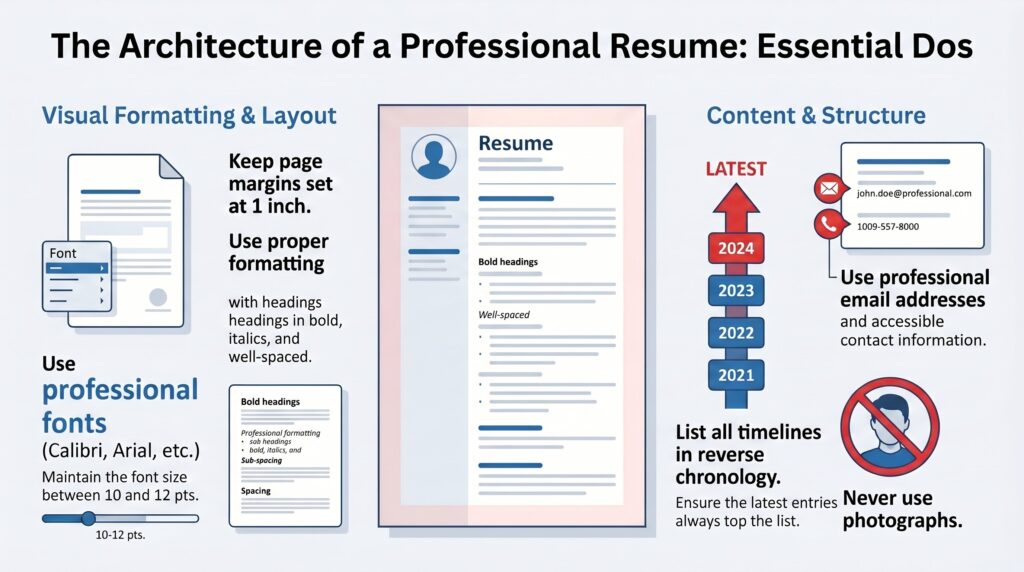
For both CVs and Resumes 

  • Use professional fonts. (Calibri, Arial, etc.)
  • Maintain the font size between 10 and 12 pts.
  • Keep page margins set at 1 inch.
  • Use proper formatting with headings in bold, italics, and well-spaced. 
  • The best way is to list all timelines in reverse chronology. (latest will top the list). 
  • Use professional email addresses and accessible contact information.
  • Never use photographs.

 For Resumes

  • Once you use the job posting, identify the keywords to define your relevant experience. Nowadays, companies use Applicant Tracking Systems (ATS), which shortlist candidates against certain keywords. 
  • Always save your resume in PDF. ATS systems can read through the PDFs. Furthermore, the risk of data mishandling and delivery is minimised. 
  • Create different versions of your resume for different roles. Especially if you are working in two different fields or making a career shift. 

Avoid These and  Make Your Resume Stand Out

There is a huge competition against every role, at every level. There is a 99 per cent chance your CV or resume may not be selected. But why? There are some of the common mistakes that applicants make. Therefore, ensure not to make these petty mistakes and make your CV or Resume stand out. 

Proofread your CV or resume multiple times to identify any spelling mistakes or formatting mistakes. Ensure your document has no misrepresentation of facts. 

Make Sure

It is important to see where you are sending your document. Choose the language dialect according to the English followed there. For the UK, Australia, New Zealand, and the EU, you will need to follow British English. For America, Asia, including Japan and South Korea, and the Philippines, use American English. 

Final Conclusion

The terms CV and resume are often used interchangeably. Therefore, this article is written for students who are soon to enter the professional world or freshers. The difference between a CV and a resume is important to know before you apply for any role. A little awareness and conscious efforts take you miles. 

Frequently Asked Questions (FAQs)

  • Are CV and Resume Different?

Yes, both documents are different to eachother. CVs are mostly important for academics and research programmes. For business and creative roles, resumes are required.

  • What is the safest way to make a CV or a Resume?

Read the requirements of the position or scholarship you are applying for. Following them with the suitable language dialect, putting the relevant information in an easy-to-scan way, is the safest way to present yourself through either a CV or a Resume.

  • Do I need a Cover Letter, also with a CV or Resume?

It is always a good idea to attach a cover letter with your CV or resume. Especially if the communication skills are a primary demand of the position you are applying for. 


Tag:cv or resume

  • Share:
shaina-mansoori

Previous post

Why Software Engineers Need MS Software Engineering?
April 20, 2026

You may also like

  • cover 1 (7)
    Why Software Engineers Need MS Software Engineering?
    18 March, 2026
  • cover 1 (7)
    Master’s of Data Science
    9 March, 2026
  • maju cover (3)
    Spring 2026: Study BS Business Analytics at MAJU
    25 February, 2026

Follow Us on Social Media

Other Links

  • Societies & Clubs
  • Scholarships and Financial Aid
  • Prospectus
  • Privacy Policy
  • FAQs
  • Harassment at Workplace
  • QEC Activities
  • University Management

Explore Maju

  • About MAJU
  • Chancellor’s Message
  • President’s Message
  • Portal
  • Student Hand Book
  • Undergraduate Regulations
  • MS Regulations
  • PhD Regulations
  • General Policies
  • Student’s Discipline
  • University Dress Code
  • Academic Calendar
  • HEC Digital Library
  • Our Team

CONTACT INFORMATION

  • Mohammad Ali Jinnah University,
    MAJU Bus Stop, Main Shahrah-e-Faisal, 22-E, Block-6, PECHS, Karachi-75400
  • +92-21-111-87-87-87
  • info@jinnah.edu
  • +92 -21-3431-1327

CONTACT US

WhatsApp us